

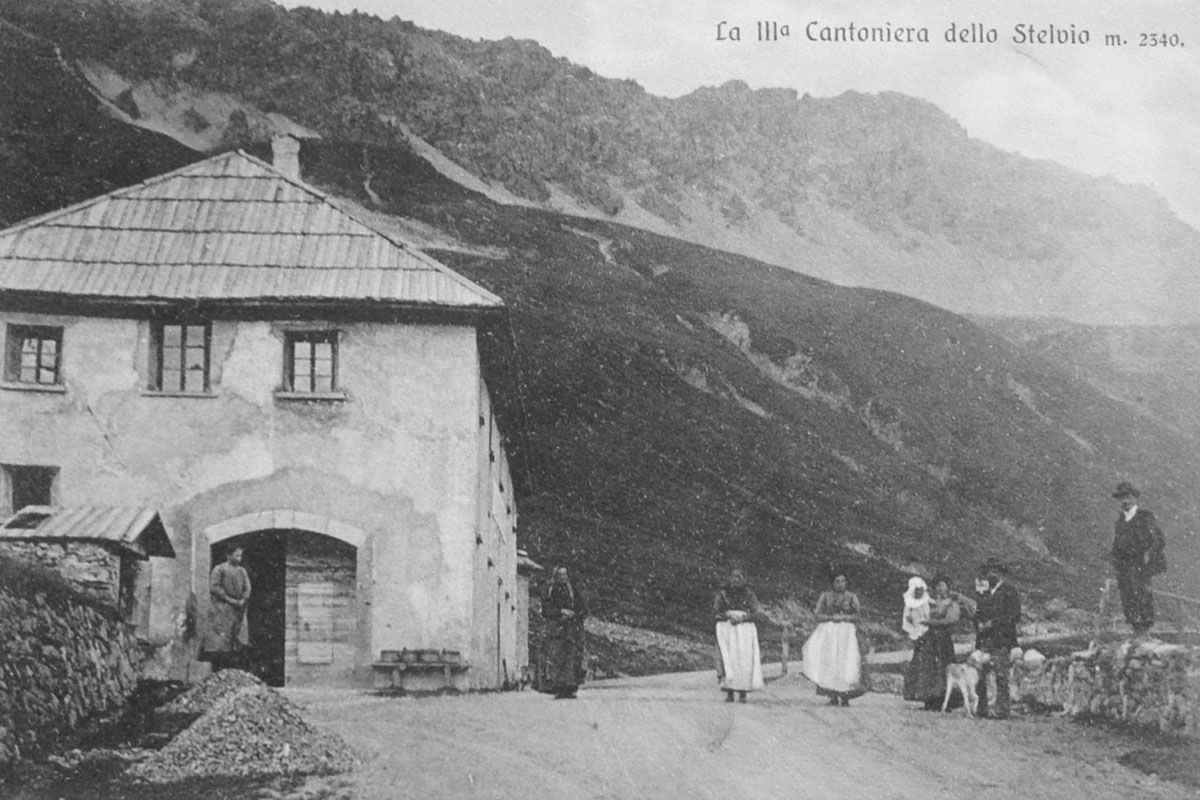
In questo scatto della III Casa Cantoniera in quota sulla strada dello Stelvio risaltano le figure femminili, ben cinque in posa per l’obiettivo del fotografo ed è molto probabile che fossero tutte coinvolte nel lavoro alla Casa Cantoniera (vi si riconoscono Maria Salvadori con il marito Tuana, che saranno i gestori ufficiali dal 1907, con la figlia Lucia di pochi mesi). A cavallo fra ottocento e Novecento lo Stelvio era diventata meta piuttosto ambita e frequentata: nel 1895 alla IV cantoniera si contarono fino a 160 coperti nel giorno di Ferragosto e sul Giogo si impiantarono le prime imprese turistiche. La locanda della III Cantoniera era pure luogo di sosta, favorito in special modo dalla presenza del cappellano della vicina chiesetta di S. Ranieri (che all’epoca conservava un pregevole quadro dell’Hayez) e dalla tradizionale attività zootecnica dell’alpe Braulio.
Stelvio III Cantoniera, 1906
AT-Archivio Tuana
Workers at the Casa Cantoniera
In this shot of the 3rd Casa Cantoniera at altitude on the Stelvio road, the female figures stand out, no less than five posing for the photographer’s lens, and it is very likely that they were all involved in the work at the Casa Cantoniera (one can recognise Maria Salvadori with her husband Tuana, who would be the official managers from 1907, with their daughter Lucia, who was only a few months old). At the turn of the 19th and 20th centuries, the Stelvio had become a popular and popular destination: in 1895, the IV Cantoniera had up to 160 guests on August 15th, and the first tourist businesses were established on the Giogo. The inn at the III Cantoniera was also a resting place, favoured in particular by the presence of the chaplain of the nearby small church of S. Ranieri (which at the time housed a valuable painting by Hayez) and by the traditional livestock activity on the Braulio alp.
Stelvio III Cantoniera, 1906
AT-Archive Tuana